SHARE


 Democratic Republic of the Congo
03-09-2026 | di COOPI
DRC, Makobola. Marie Esther's witness
Marie Esther lived in Uvira, in the South Kivu province in the eastern Democratic Republic of the Congo, with her husband and their four children aged 10, 8, 5, and 20 months. The family lived modestly, primarily through Marie Esther's agricultural activities and her husband's work as a motorcycle taxi driver. In December 2025, the clashes between the armed group M23-AFC and the Armed Forces of the Democratic Republic of the Congo (FARDC) profoundly changed the family's life.
Marie Esther confides:
I lost my husband to the violence. Since that day, I have been alone with my children and I must do everything to take care of them.
To escape the violence and insecurity, she sought refuge with her four children in Makobola, a town located 15 kilometers south of the city of Uvira, where a host family of 14 people took them in. Unfortunately, despite this support, Marie Esther and her children face difficult living conditions. She tells us:
The family hosting us is large and they also have difficulties. I do small jobs to help around the house and take care of my children, but what I earn is not always enough.
This situation profoundly affected Marie Esther's youngest child, Chance, who is only 20 months old. On June 26, 2026, she was diagnosed with severe acute malnutrition during a community screening organized as part of the project "Emergency humanitarian nutrition response to IDPs and host communities affected by the Uvira crisis in the Uvira and Lemera Health Zones", implemented by COOPI – Cooperazione Internazionale and AFPDE (Women Association for the Promotion and the Endogenous Development) with funding from the Humanitarian Fund (OCHA) in the DRC. As Mr. Patient, a COOPI field Nutritionist, testifies:
When I saw the little girl, I immediately understood that the situation was serious and that she needed appropriate care. The little one indeed presented severe acute malnutrition accompanied by clinical complications. Her mother didn't seem to realize the severity of her condition. I explained to her that she had to take her to the Makobola Health Center for a thorough evaluation.
The tests carried out at the hospital center confirmed the diagnosis and Chance was referred to the Intensive Therapeutic Nutritional Unit (UNTI) to receive free medical and nutritional care. Marie Esther recounts:
I didn't think my child was so sick. I just wanted her to get better. At the hospital, the staff welcomed us well and took good care of my child. That reassured me and gave me hope.
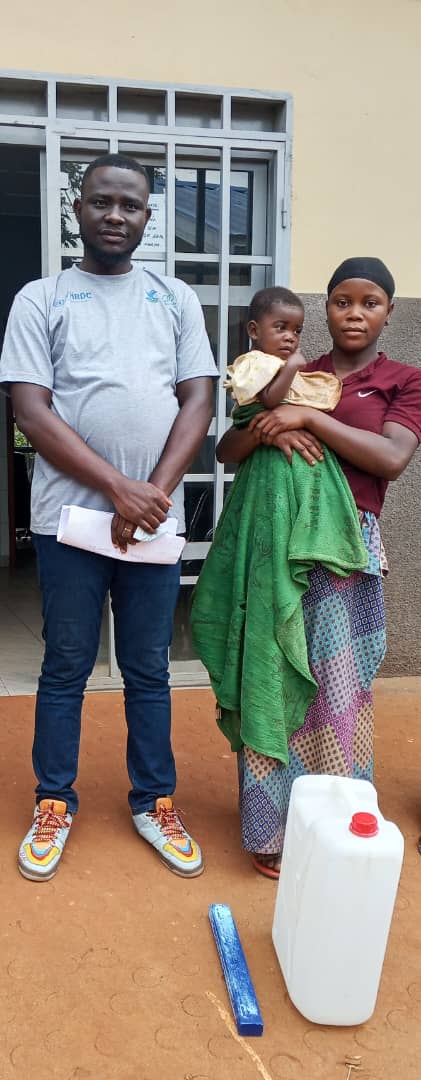 After two weeks of intensive treatment, Chance's health condition significantly improved, and she was transferred to the Ambulatory Therapeutic Nutritional Unit (UNTA) for regular monitoring. At the same time, Marie Esther received a hygiene kit (containing a 20-liter jerrycan for water, cups, and soap), also provided as part of the project by COOPI with DRC HF funding, as well as awareness sessions on good feeding and hygiene practices. These interventions make it possible to influence the family's daily practices, in order to help prevent new episodes of malnutrition and promote the child's well-being. Today, Marie Esther has acquired new knowledge about nutrition and how to care for her children. She testifies:
The COOPI and AFPDE team explained to me that I had to continue breastfeeding my little girl until the age of two and prepare different meals for her every day. I am doing my best to follow this advice.
Empowered by this experience, she has become a true ambassador for the fight against malnutrition in her community, as she testifies:
Today, I raise awareness among my neighbors and acquaintances to have their children screened. I tell them that care is free and that a sick child can regain their health when treated in time. My story gives me the strength to help other families protect their children.
Chance is among the 142 children suffering from severe acute malnutrition with medical complications who have received treatment thanks to the project "Emergency humanitarian nutrition response to IDPs and host communities affected by the Uvira crisis in the Uvira and Lemera Health Zones". Her journey bears witness to the impact that solidarity, community engagement, and access to quality care can have in protecting the health and well-being of children and communities affected by conflicts.